> ## Documentation Index
> Fetch the complete documentation index at: https://docs.commitplus.app/llms.txt
> Use this file to discover all available pages before exploring further.
# Self-hosted Git providers
> Connect GitHub Enterprise Server and GitLab Self-Managed accounts to use private repositories, Git operations, and pull request workflows in Commit+.
Commit+ Pro supports GitHub Enterprise Server and GitLab Self-Managed alongside GitHub.com and GitLab.com. Connect your company server once, then use its repositories and credentials throughout the app.
## Connect your server
1. Open **Settings → Account** and find **Git Provider Accounts**.
2. Click **Add**, then select **GitHub** or **GitLab**.
3. Enable **Self-hosted server (Pro)**.
4. Enter the server's HTTPS URL, including a custom port or installation subpath when required.
5. Keep **HTTPS** selected, enter a personal access token, then click **Connect Account**.
6. After Commit+ displays the connected username, click **Save**.
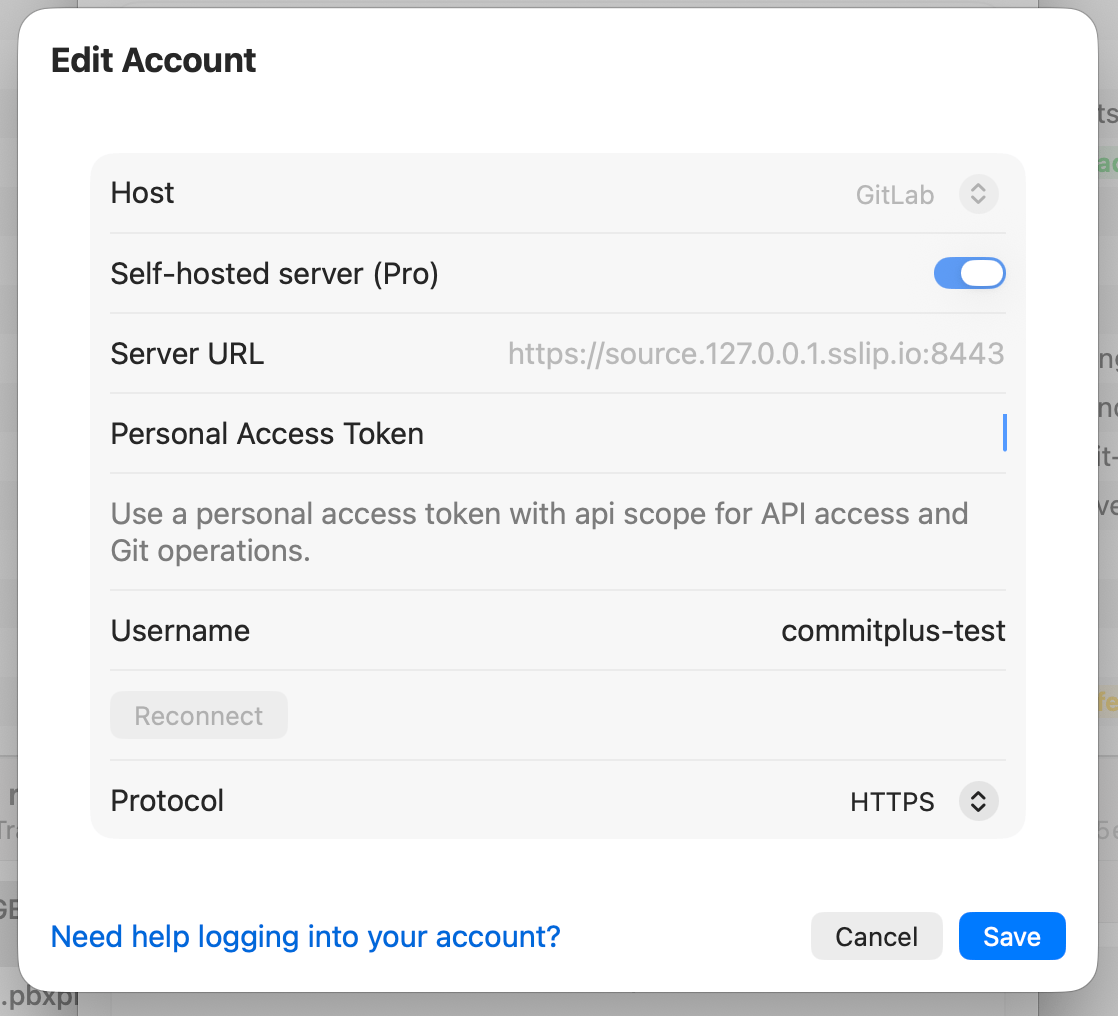 The server URL must use HTTPS. For example:
* GitHub Enterprise Server: `https://github.company.com`
* GitLab Self-Managed: `https://gitlab.company.com`
* GitLab with a custom port or subpath: `https://source.company.com:8443/gitlab`
Commit+ validates the token against the server's user API before saving the account. Public GitHub and GitLab accounts continue to use their existing OAuth connection flow; self-hosted accounts use personal access tokens.
## Personal access token permissions
Your token must be able to access the repositories and API actions you want to use.
A classic personal access token with the `repo` scope covers private repositories. Add the `workflow` scope if you need to push changes to GitHub Actions workflow files.
Fine-grained token support and available permissions depend on your GitHub Enterprise Server version and administrator policy.
Create a personal access token with the `api` scope. Commit+ uses it for both provider API access and HTTPS Git operations.
A successful connection confirms your identity, but it does not guarantee access to every repository. Server policy, SSO rules, token permissions, and repository permissions still apply.
## Use self-hosted repositories
After connecting an account, Commit+ routes supported workflows to its configured server:
* Browse repositories from the **Clone** window under **Browse connected repositories**.
* Clone private repositories over HTTPS using the matching stored credential.
* Fetch, pull, and push without entering the token again.
* Load remote branches and repository visibility.
* Browse pull requests or merge requests and use the supported PR/MR actions.
* Read branch protection information when the server and token expose it.
Repository discovery shows repositories returned for the connected token. GitLab limits this list to repositories where the account is a member. Use **Load more** when the server has additional result pages.
## Use SSH for Git operations
You can select **SSH**, choose a private key, and test it against the configured hostname. Commit+ respects your SSH configuration, including host aliases and custom SSH ports.
SSH authentication covers Git transport only. Keep an API token on the account if you also want repository discovery or pull request and merge request features.
An HTTPS API port is not automatically an SSH port. If multiple installations share one hostname, an SSH remote cannot identify the server's HTTPS port or subpath; use HTTPS or configure the mapping in your existing Git and SSH setup.
## Security and account changes
Personal access tokens and SSH keys stay in the local macOS Keychain. Commit+ does not disable HTTPS certificate validation.
To rotate an expired or revoked token, edit the provider account, enter the replacement token, click **Reconnect**, then save the account. Connecting or reconnecting a self-hosted server requires an active Commit+ Pro plan.
## Troubleshooting
Check the full server URL, DNS, network connection, and company VPN. Include any required HTTPS port or installation subpath.
Install and trust your organization's certificate in macOS Keychain. Commit+ requires normal HTTPS certificate validation.
Edit the account and reconnect with a replacement personal access token.
Verify the token scopes, repository membership, SSO authorization, and administrator policies for the server. Reconnecting the account does not add permissions to the token.
This documentation is built and hosted on [Mintlify](https://mintlify.com), a developer documentation platform.
The server URL must use HTTPS. For example:
* GitHub Enterprise Server: `https://github.company.com`
* GitLab Self-Managed: `https://gitlab.company.com`
* GitLab with a custom port or subpath: `https://source.company.com:8443/gitlab`
Commit+ validates the token against the server's user API before saving the account. Public GitHub and GitLab accounts continue to use their existing OAuth connection flow; self-hosted accounts use personal access tokens.
## Personal access token permissions
Your token must be able to access the repositories and API actions you want to use.
A classic personal access token with the `repo` scope covers private repositories. Add the `workflow` scope if you need to push changes to GitHub Actions workflow files.
Fine-grained token support and available permissions depend on your GitHub Enterprise Server version and administrator policy.
Create a personal access token with the `api` scope. Commit+ uses it for both provider API access and HTTPS Git operations.
A successful connection confirms your identity, but it does not guarantee access to every repository. Server policy, SSO rules, token permissions, and repository permissions still apply.
## Use self-hosted repositories
After connecting an account, Commit+ routes supported workflows to its configured server:
* Browse repositories from the **Clone** window under **Browse connected repositories**.
* Clone private repositories over HTTPS using the matching stored credential.
* Fetch, pull, and push without entering the token again.
* Load remote branches and repository visibility.
* Browse pull requests or merge requests and use the supported PR/MR actions.
* Read branch protection information when the server and token expose it.
Repository discovery shows repositories returned for the connected token. GitLab limits this list to repositories where the account is a member. Use **Load more** when the server has additional result pages.
## Use SSH for Git operations
You can select **SSH**, choose a private key, and test it against the configured hostname. Commit+ respects your SSH configuration, including host aliases and custom SSH ports.
SSH authentication covers Git transport only. Keep an API token on the account if you also want repository discovery or pull request and merge request features.
An HTTPS API port is not automatically an SSH port. If multiple installations share one hostname, an SSH remote cannot identify the server's HTTPS port or subpath; use HTTPS or configure the mapping in your existing Git and SSH setup.
## Security and account changes
Personal access tokens and SSH keys stay in the local macOS Keychain. Commit+ does not disable HTTPS certificate validation.
To rotate an expired or revoked token, edit the provider account, enter the replacement token, click **Reconnect**, then save the account. Connecting or reconnecting a self-hosted server requires an active Commit+ Pro plan.
## Troubleshooting
Check the full server URL, DNS, network connection, and company VPN. Include any required HTTPS port or installation subpath.
Install and trust your organization's certificate in macOS Keychain. Commit+ requires normal HTTPS certificate validation.
Edit the account and reconnect with a replacement personal access token.
Verify the token scopes, repository membership, SSO authorization, and administrator policies for the server. Reconnecting the account does not add permissions to the token.
This documentation is built and hosted on [Mintlify](https://mintlify.com), a developer documentation platform.